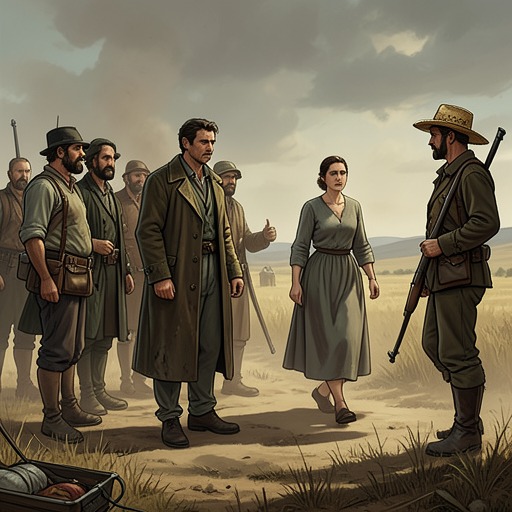
Bernard Brady
Under the Banner of HeavenBernard Brady’s place in the events surrounding the Lafferty murders was shaped by a consequential divide: he helped bring together the men and institutions from which Ron Lafferty’s violent revelation emerged, yet he also rejected that revelation and recorded his fear of it. A Utah businessman and Dream Mine investor, Brady helped launch Onias’s School of the Prophets and introduced five Lafferty brothers to it. When Ron later showed him a commandment calling for four people to be removed, Brady objected—but kept his warning from the other members and the police. His affidavit eventually surfaced in the investigation, alongside a troubling question the book leaves visible: recognizing danger did not lead him to report it.
Business and Entry into Fundamentalism
In the early 1980s, Brady became business partners with Kenyon Blackmore in Utah County. Blackmore, an affable Mormon, converted Brady to fundamentalism; together they sold shares in tax-sheltered financial trusts and invested in the legendary Dream Mine above Salem, Utah. Millions of dollars flowed into their business account, and each partner bought a lavish home below the mine. The apparent prosperity connected Brady not only to a religious network but also to a major financial enterprise that would soon collapse under legal scrutiny.
That scrutiny had begun before the Lafferty murders. In 1983, a federal grand jury indicted Blackmore, Brady, and nineteen other partners on multiple fraud counts, alleging that they had bilked more than $32 million from 3,800 investors. The prosecuting United States Attorney described the scheme as a classic Ponzi scheme. Brady was arrested, tried, and eventually sent to federal prison for six years. Blackmore, by contrast, went into hiding after learning of the indictments, fleeing to Mexico, where his family sheltered him in Colonia LeBaron. The contrast marked a decisive break in the partners’ paths: Brady faced prosecution and imprisonment, while Blackmore evaded surrender.
The School of the Prophets and the Lafferty Brothers
Blackmore also connected Brady to Onias, a longtime friend he had met while working as a schoolteacher in Bountiful, British Columbia. Onias had moved to Utah County to build a City of Refuge below the Dream Mine and was organizing the School of the Prophets. He invited Brady to join. In turn, Brady recruited five brothers from what he regarded as an outstanding Utah County family: Tim, Watson, Mark, Dan, and Ron Lafferty. Allen was not among the brothers brought together with Onias on the occasion described in the book.
Near the end of 1983, Brady brought Onias and the Lafferty brothers together for an evening meeting. The men felt an immediate kinship and shared values, and spoke with excitement late into the night. Those present believed their combined efforts could alter human history. In retrospect, that gathering joined a self-proclaimed prophet seeking followers with brothers ready to commit themselves to a divinely empowered mission; Brady was the connector who made the introduction.
Brady’s contribution to the school was practical as well as social. The Lafferty brothers undertook the laborious work of printing, folding, and collating more than 15,000 of Onias’s pamphlets, then addressing and mailing them to LDS leaders across the country. They completed the job in two weeks, working day and night, a task Onias thought would otherwise have taken months of spare-time work. By early 1984, the School of the Prophets met weekly, usually upstairs from the family chiropractic clinic in Claudine Lafferty’s home in Provo, Utah. Onias credited the brothers’ energy with helping the school get off to a strong start, and saw them as pivotal to its success.
Ron’s Revelation and Brady’s Private Objection
Within the school, revelations were not simply received and kept by their authors: the standard procedure was to present each commandment to the other members for evaluation. Ron began receiving revelations in February 1984. On February 24, using a computer he had borrowed from Brady, he closed his eyes and waited for what he understood to be divine direction as he typed. He received further revelations on February 25 and 27. The computer Brady had lent him thus became part of the process through which Ron produced most of his revelations.
On March 22, shortly before a weekly meeting at Claudine Lafferty’s home, Ron took Brady into a side room and handed him the removal revelation to review. Brady read it and objected, telling Ron that it frightened him and that he wanted nothing to do with it because he believed it was wrong. Yet when the meeting began minutes later, neither man told the other members about the document. The school’s stated practice of communal evaluation was therefore not followed openly in this instance: Brady’s rejection remained a private exchange rather than becoming a warning to the group.
Brady’s concern persisted. On April 9, he signed and had notarized an affidavit recording that Ron had shown him the revelation and that he wanted no part in it. He feared Ron might carry it out and murder the four people it named. But Brady did not alert the police, and no other member of the School of the Prophets did so either. He placed the affidavit in a desk drawer at home, intending to establish that he was blameless if Ron killed anyone. The document preserved his objection, but its private filing also meant that it did not serve as a timely warning to authorities.
The Murders and the Discovery of the Affidavit
Brenda and Erica Lafferty were murdered in American Fork, Utah, on July 24, 1984. Early the following morning, as Brady was preparing for work, Tim Lafferty called to tell him that Ron and Dan had carried out the revelation and killed people the day before. Brady was overwhelmed by the news. The call transformed the danger he had feared into a fact, and connected the revelation he had kept in a drawer to the murders now under investigation.
When Brady arrived home from work on July 25, police cars filled the street and officers were inside his house. His family sat on the couch, having been told not to move or they would be shot. Brady had become a person of interest because of his association with the School of the Prophets, as had Blackmore and others connected to it. During a search, officers found the April affidavit in a drawer. They also seized files concerning the school and the computer Ron had used to type most of his revelations. That computer did not contain the removal revelation.
The original document was found in a later search of an unoccupied house where Ron had been staying before he and Dan began their road trip. In a closet, officers discovered a flannel shirt; in its breast pocket was a note on yellow legal paper, written in Ron’s tidy handwriting. It was the original removal revelation. The distinction between the computer’s missing file and the paper original helped establish how the evidence was distributed: Brady’s affidavit documented his prior knowledge and objection, while the original revelation was recovered elsewhere.
Significance and Consequences
Brady’s story brings together two forms of involvement that cannot be reduced to either full complicity or complete distance. He recruited the Lafferty brothers into Onias’s school, supported the school’s work through his association with Onias, and lent Ron the computer used to type revelations. When confronted with the removal revelation, however, he rejected it and formally recorded his concern. The same account also specifies the limits of that opposition: he neither raised the revelation at the group meeting nor contacted the police, instead placing the affidavit where it could later support his own claim of blamelessness.
His business history supplies a separate but connected consequence. Brady’s partnership with Blackmore, their financial-trust sales, and their Dream Mine investment appeared prosperous before the fraud indictment brought the enterprise to an end. Brady’s arrest, trial, and six-year federal prison term formed one aftermath; the murder investigation’s search of his home, the discovery of his affidavit, and the seizure of school records formed another. Across both, documents and systems of record—the indictment, the affidavit, the computer files, and Ron’s handwritten note—became ways of tracing what Brady had helped set in motion, what he had objected to, and what he had not reported.